

 Set up docs MCP
ClickHouse Connect is a core database driver providing interoperability with a wide range of Python applications.
- The main interfaces are the synchronous
Clientand native aiohttp-basedAsyncClientinclickhouse_connect.driver. The driver package also provides query and insert contexts, streaming helpers, DB-API support, and lower-level HTTP methods. - The
clickhouse_connect.datatypespackage serializes and deserializes ClickHouse types using the ClickHouse Native binary columnar format. - The optional Cython extensions in
clickhouse_connect.drivercaccelerate common serialization, conversion, and buffering paths. A pure Python path remains available on platforms where the extensions cannot be built. An experimental opt-in Rust codec can replace Native format processing entirely. - The package ships PEP 561 type information, so downstream type checkers consume annotations for the public driver, DB-API, and SQLAlchemy surfaces.
- The SQLAlchemy dialect in
clickhouse_connect.cc_sqlalchemysupports SQLAlchemy Core, schema reflection, ClickHouse-specific query clauses and table engines, and Alembic migrations. Basic ORM reads and inserts work, but the dialect is designed for analytical workloads rather than full unit-of-work ORM behavior. - The core driver and ClickHouse Connect SQLAlchemy implementation are the preferred method for connecting ClickHouse to Apache Superset. Use the
ClickHouse Connectdatabase connection, orclickhousedbSQLAlchemy dialect connection string.
This documentation is current as of clickhouse-connect 1.6.0. If you are upgrading from 0.15.x or earlier, see the 1.0 migration guide.
Requirements and compatibility
| Component | Supported versions |
|---|---|
| Python | 3.10 through 3.14. Free-threaded builds such as 3.14t are supported experimentally. |
| ClickHouse | Actively supported ClickHouse releases. CI tests against recent LTS and stable server releases. |
| SQLAlchemy | 1.4.40 or later, below 3.0 |
| Pandas | 2.x and 3.x |
| Polars | 1.0 or later |
| aiohttp | 3.9 or later |
| Platforms | Linux, macOS, and Windows on the wheel architectures published for each Python version |
The package includes compiled wheels where available and falls back to a pure Python implementation when the Cython extensions cannot be built. PyArrow is supported on Python 3.10 through 3.14. Python 3.14 requires PyArrow 22 or later.
Installation
Install ClickHouse Connect from PyPI via pip:
pip install clickhouse-connectOptional integrations are installed through extras:
pip install "clickhouse-connect[async]"      # Native asyncio client
pip install "clickhouse-connect[pandas]"     # Pandas
pip install "clickhouse-connect[arrow]"      # PyArrow
pip install "clickhouse-connect[polars]"     # Polars
pip install "clickhouse-connect[sqlalchemy]" # SQLAlchemy dialect
pip install "clickhouse-connect[alembic]"    # SQLAlchemy and Alembic
pip install "clickhouse-connect[chdb]"       # Embedded chDB backend
pip install "clickhouse-connect[rust,arrow]" # Experimental Rust codec evaluation setup
pip install "clickhouse-connect[tzdata]"     # IANA time zones on minimal systems
ClickHouse Connect can also be installed from source:
git clonethe GitHub repository.- Change to the project root and run
pip install .. The build system installs Cython automatically to compile the optional C extensions.
Source build modes
Source builds support three modes. Default and required modes fail if Cython is unavailable or cythonize() fails. Skip mode does not import Cython.
| Mode | Command | Behavior |
|---|---|---|
| Default | pip install . |
Attempts to compile the C extensions. If the compiler or linker fails, the build falls back to a pure Python install. |
| Pure Python | CLICKHOUSE_CONNECT_SKIP_CYTHON=1 pip install . |
Builds pure Python without attempting the extensions. |
| Required | CLICKHOUSE_CONNECT_REQUIRE_C=1 pip install . |
Fails the build if the extensions cannot be compiled. Recommended for CI and for building redistributable wheels. |
Setting both CLICKHOUSE_CONNECT_SKIP_CYTHON=1 and CLICKHOUSE_CONNECT_REQUIRE_C=1 is an error.
Default fallback wheels contain no compiled extensions but retain platform and interpreter tags. Only skip mode produces py3-none-any. pip can cache a fallback wheel built from an index sdist and reuse it for a compatible Python and platform after the compiler is fixed. Clear it with:
pip cache remove clickhouse_connectCheck whether all three extension modules are present. This prints True when they are:
python -c "from importlib.util import find_spec; print(all(find_spec(m) for m in ('clickhouse_connect.driverc.buffer', 'clickhouse_connect.driverc.dataconv', 'clickhouse_connect.driverc.npconv')))"Importing clickhouse_connect.driverc.npconv directly also requires NumPy to be installed.
The installed version is available as clickhouse_connect.__version__.
Support policy
Update to the latest ClickHouse Connect release before reporting an issue. File issues in the GitHub project. ClickHouse Connect targets the actively supported ClickHouse releases at the time of each driver release. It often works with older server versions, but newer data types and protocol features can require a newer server.
Basic usage
Gather your connection details
To connect to ClickHouse with HTTP(S) you need this information:
| Parameter(s) | Description |
|---|---|
HOST and PORT |
Typically, the port is 8443 when using TLS or 8123 when not using TLS. |
DATABASE NAME |
Out of the box, there is a database named default, use the name of the database that you want to connect to. |
USERNAME and PASSWORD |
Out of the box, the username is default. Use the username appropriate for your use case. |
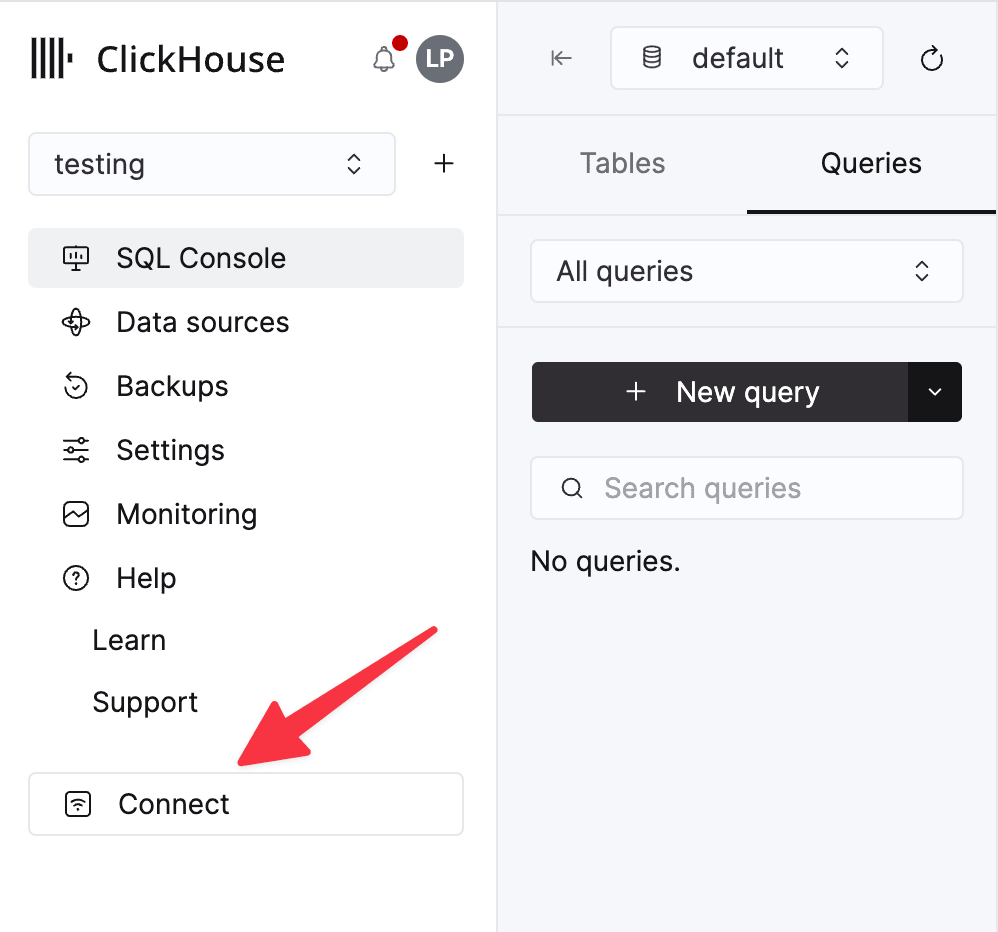
The details for your ClickHouse Cloud service are available in the ClickHouse Cloud console. Select a service and click Connect:
Choose HTTPS. Connection details are displayed in an example curl command.
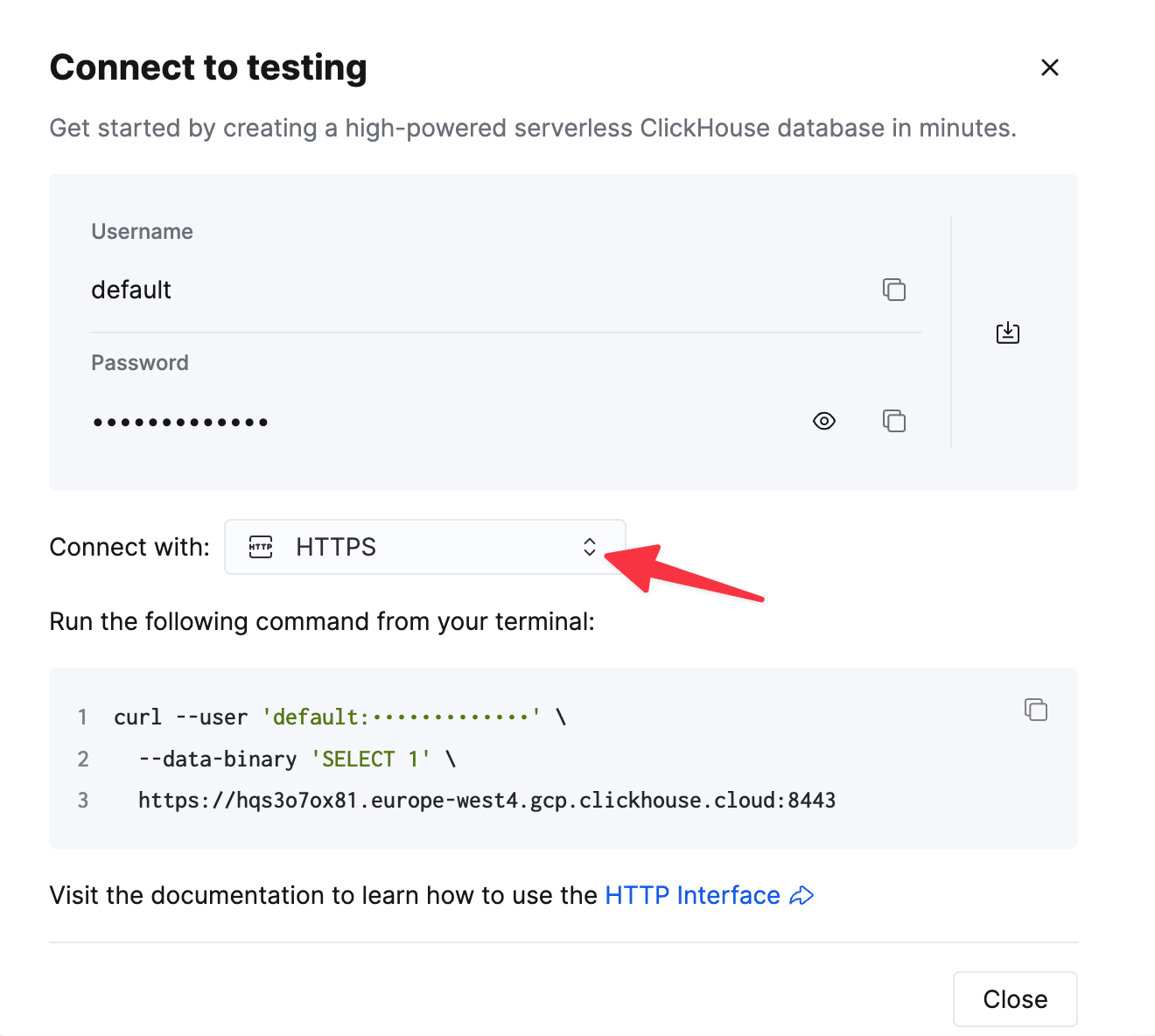
If you’re using self-managed ClickHouse, the connection details are set by your ClickHouse administrator.
Establish a connection
There are two examples shown for connecting to ClickHouse:
- Connecting to a ClickHouse server on localhost.
- Connecting to a ClickHouse Cloud service.
Use a ClickHouse Connect client instance to connect to a ClickHouse server on localhost:
import clickhouse_connect

client = clickhouse_connect.get_client(
    host="localhost",
    username="default",
    password="password",
)
Use a ClickHouse Connect client instance to connect to a ClickHouse Cloud service:
import clickhouse_connect

client = clickhouse_connect.get_client(
    host="HOSTNAME.clickhouse.cloud",
    port=8443,
    username="default",
    password="your password",
)
Interact with your database
To run a ClickHouse SQL command, use the client command method:
client.command(
    "CREATE TABLE new_table "
    "(key UInt32, value String, metric Float64) "
    "ENGINE MergeTree ORDER BY key"
)
To insert batch data, use the client insert method with a two-dimensional array of rows and values:
row1 = [1000, "String Value 1000", 5.233]
row2 = [2000, "String Value 2000", -107.04]
data = [row1, row2]
client.insert("new_table", data, column_names=["key", "value", "metric"])
To retrieve data using ClickHouse SQL, use the client query method:
result = client.query("SELECT max(key), avg(metric) FROM new_table")
print(result.result_rows)
# Output: [(2000, -50.9035)]

client.close()
Embedded chDB backend
The experimental chDB backend runs ClickHouse queries inside the Python process without an HTTP server. Install the chdb extra, then select the backend with interface="chdb" or a chdb:// DSN:
import clickhouse_connect

with clickhouse_connect.get_client(interface="chdb") as client:
    result = client.query("SELECT number FROM numbers(3)")
    print(result.result_rows)
    # Output: [(0,), (1,), (2,)]
The default database is in memory. Pass path="/data/my_chdb" or use dsn="chdb:///data/my_chdb" for persistent storage. chDB allows one engine path per process. It does not support the async client or external data.